
Business intelligence is evolving faster than ever as organizations increasingly rely on data-driven decision-making, cloud analytics, automation, and artificial intelligence. In this rapidly changing landscape, Microsoft Power BI continues to remain one of the most influential analytics platforms for modern businesses.
Over the past few years, Power BI has transformed from a dashboarding tool into a broader analytics ecosystem that supports:
- Real-time reporting
- AI-powered insights
- Enterprise-scale analytics
- Cloud intelligence
- Predictive decision-making
- Unified data experiences
As we move deeper into 2026, organizations are no longer using Power BI solely for static reporting. Businesses now expect intelligent dashboards, automated workflows, real-time analytics, and integrated AI capabilities that can help teams make faster and smarter decisions.
At KnexBI, organizations increasingly adopt modern Power BI strategies to build scalable analytics environments, improve operational intelligence, and modernize enterprise reporting systems.
In this article, we’ll explore the top Power BI trends shaping business intelligence in 2026 and how these innovations are changing the future of analytics.
The Growing Importance of Power BI in Modern Analytics
Before exploring the trends themselves, it’s important to understand why Power BI continues gaining adoption globally. Modern businesses generate enormous volumes of data from a multitude of disparate systems.
Modern businesses generate enormous volumes of data from:
- Cloud applications
- Websites
- Ecommerce platforms
- CRM systems
- ERP software
- Marketing platforms
- IoT devices
- Operational systems
The challenge is no longer collecting data. The challenge is transforming that data into actionable intelligence quickly and efficiently. Power BI helps organizations:
- Centralize reporting
- Visualize complex datasets
- Track KPIs in real time
- Improve operational visibility
- Enhance executive decision-making
As analytics becomes increasingly central to business operations, Power BI’s role continues expanding far beyond traditional reporting.
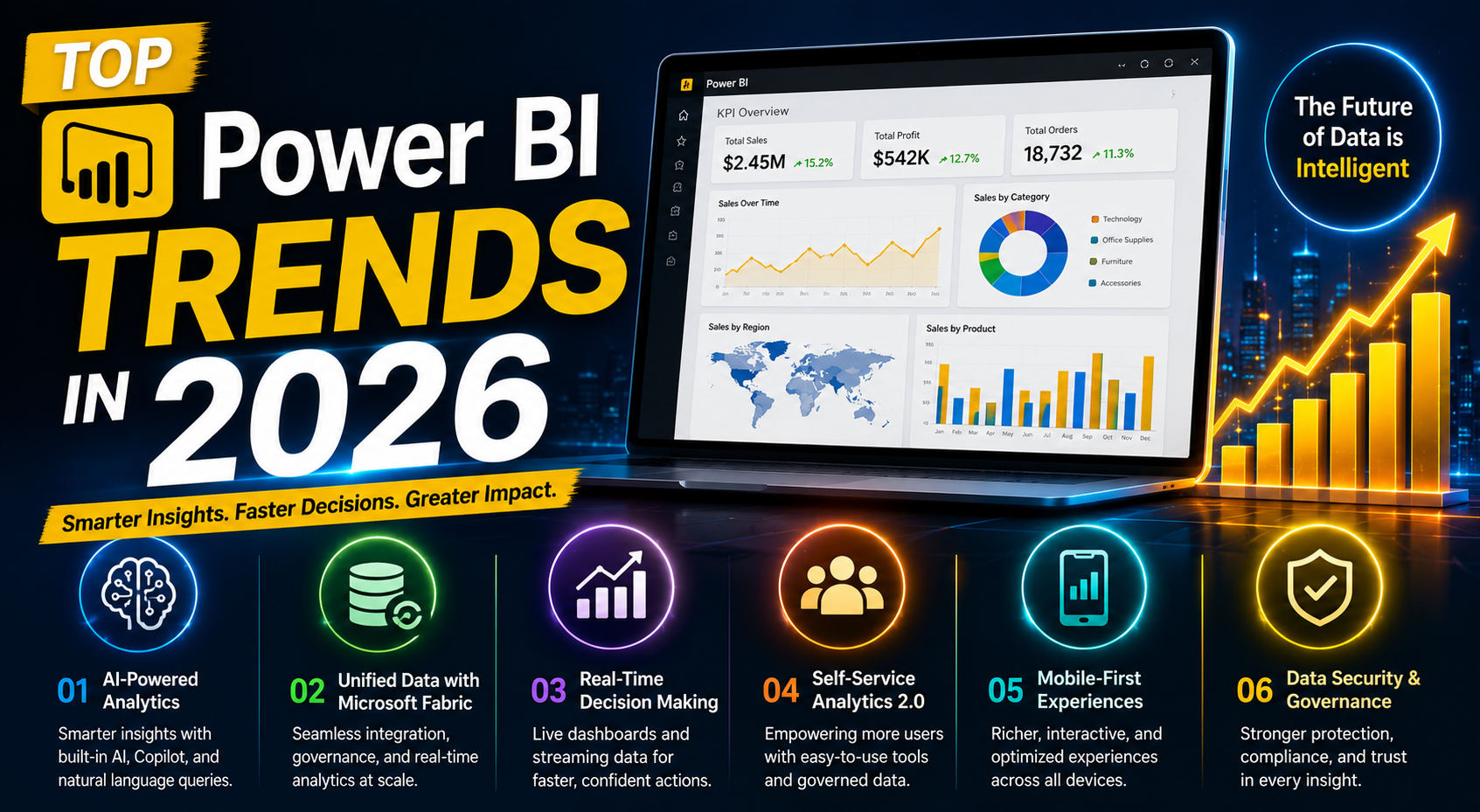
1. AI-Powered Analytics is Becoming Mainstream
One of the biggest Power BI trends in 2026 is the rapid integration of artificial intelligence into analytics workflows. Businesses no longer want dashboards that simply display historical data.
They want systems that can:
- Predict outcomes
- Detect anomalies
- Recommend actions
- Generate insights automatically
Microsoft has significantly expanded AI capabilities within Power BI through:
- Copilot integration
- Natural language querying
- AI visuals
- Automated insights
- Machine learning integration
This trend is making analytics more accessible to non-technical users. For example, business users can now ask questions in plain language such as: “Why did sales decline this quarter?”, “Which regions have the highest customer churn?”, or “Forecast next month’s revenue trends.” AI-powered reporting dramatically reduces the complexity of data analysis.
2. Microsoft Fabric Integration is Reshaping Analytics
Another major trend is the growing adoption of Microsoft Fabric alongside Power BI. Microsoft Fabric is transforming analytics by unifying data engineering, data warehousing, real-time analytics, data science, and business intelligence. Power BI is now becoming part of a larger connected analytics ecosystem rather than functioning as an isolated reporting platform.
This integration enables organizations to:
- Centralize analytics operations
- Reduce fragmented tools
- Improve governance
- Build scalable cloud architectures
Businesses investing in enterprise analytics increasingly combine Power BI with Fabric to create end-to-end intelligent data environments.
3. Real-Time Analytics is Growing Rapidly
In 2026, businesses increasingly demand real-time visibility into operations. Traditional reporting systems that refresh once daily are no longer sufficient for many industries. Organizations now expect dashboards that update instantly using live streaming data.
Real-time Power BI analytics is becoming more common across:
- Ecommerce
- Manufacturing
- Logistics
- Healthcare
- Financial services
- Marketing operations
Examples include:
- Live sales tracking
- Website traffic monitoring
- Operational alerts
- Supply chain analytics
- Fraud detection dashboards
Real-time reporting enables businesses to respond faster to changing conditions.
4. Self-Service BI Continues Expanding
One of Power BI’s greatest strengths has always been self-service analytics. In 2026, more organizations are empowering non-technical users to create dashboards and reports independently.
Departments such as:
- Marketing
- Finance
- HR
- Operations
- Sales
This democratization of analytics improves:
- Decision-making speed
- Operational agility
- Data accessibility
- Business collaboration
Power BI’s user-friendly interface remains a major reason for its continued enterprise growth.
5. Data Governance and Security are Becoming Critical
As organizations scale analytics environments, governance has become a top priority. Businesses now manage sensitive customer data, financial information, operational intelligence, and compliance-related reporting.
Power BI trends in 2026 increasingly focus on:
- Role-based access control
- Data lineage
- Security governance
- Centralized semantic models
- Enterprise compliance
Organizations are building stronger governance frameworks to ensure analytics environments remain secure and scalable.
6. Semantic Models are Becoming More Important
Large organizations increasingly use centralized semantic models to standardize analytics. Semantic models create a single trusted layer for KPIs, business definitions, metrics, and calculations. This helps organizations eliminate inconsistent reporting across departments.
Without semantic modeling: Finance may calculate revenue differently from sales teams.
With centralized semantic models: All teams use consistent metrics and logic. This trend improves reporting reliability and organizational alignment.
7. Cloud-Native Analytics Adoption is Accelerating
Businesses are rapidly moving away from on-premise reporting systems. Cloud-native analytics enables scalability, faster deployment, global accessibility, and reduced infrastructure costs. Power BI’s strong integration with Azure continues driving adoption among cloud-focused organizations.
Cloud-based reporting environments support:
- Remote teams
- Global collaboration
- Real-time synchronization
- Elastic compute scaling
8. Embedded Analytics is Becoming More Popular
Organizations increasingly integrate Power BI dashboards directly into websites, SaaS applications, customer portals, and enterprise systems. Embedded analytics allows businesses to provide real-time insights within their existing applications instead of requiring users to switch platforms.
This trend is especially strong among:
- SaaS companies
- Ecommerce platforms
- Customer experience applications
- Enterprise software providers
9. Power BI Performance Optimization is a Major Focus
As datasets continue growing larger, performance optimization has become increasingly important. Slow dashboards negatively affect adoption and user experience.
Organizations now prioritize:
- Faster dashboard loading
- Efficient DAX calculations
- Optimized data models
- Incremental refresh
- Aggregation strategies
Businesses increasingly invest in:
- Star schema optimization
- Efficient semantic models
- Better data architecture
- Query optimization
10. AI-Assisted Dashboard Development is Emerging
AI is not only improving analytics consumption but also dashboard development itself. Power BI now supports AI-assisted capabilities that help users generate visuals automatically, create summaries, detect trends, and build reports faster.
In the future, AI may increasingly automate dashboard layouts, KPI recommendations, data model optimization, and report generation. This trend could significantly reduce development complexity.
11. Mobile Business Intelligence is Expanding
Executives and decision-makers increasingly access analytics on mobile devices. Modern businesses expect dashboards optimized for smartphones, tablets, and remote work environments.
Power BI mobile experiences continue improving to support:
- Real-time alerts
- Interactive dashboards
- Mobile-friendly visualizations
12. Predictive Analytics is Becoming More Accessible
Predictive analytics was once limited to advanced data science teams. Now, Power BI increasingly enables businesses to integrate forecasting, trend analysis, predictive modeling, and machine learning outputs into standard dashboards. This helps organizations move from reactive reporting to proactive decision-making.
13. Industry-Specific Analytics Solutions are Growing
Businesses increasingly seek specialized Power BI solutions tailored to their specific industries to improve relevance, KPI alignment, and operational efficiency.
Examples include:
- Healthcare dashboards
- Financial analytics
- Retail intelligence
- Manufacturing reporting
- HR analytics
- Marketing attribution dashboards
14. Sustainability and ESG Reporting is Increasing
Environmental, Social, and Governance (ESG) reporting continues growing globally. Organizations increasingly use Power BI to track sustainability metrics, carbon emissions, energy usage, and ESG performance indicators. Power BI’s visualization capabilities make it highly effective for ESG reporting initiatives as compliance requirements evolve.
15. Hybrid Analytics Architectures are Emerging
Many enterprises now operate hybrid environments combining cloud systems, on-premise databases, SaaS applications, and data lakes. Power BI increasingly supports hybrid analytics workflows that unify distributed data sources into centralized reporting systems, helping large enterprises undergoing digital transformation.
Challenges Businesses Still Face with Power BI
Despite rapid innovation, technology alone is not enough without proper analytics planning.
Organizations still face structural challenges such as:
- Poor data modeling
- Dashboard sprawl
- Governance complexity
- Slow performance
- Data silos
- User adoption barriers
Successful Power BI implementations increasingly require:
- Strong architecture
- Governance frameworks
- Scalable data strategies
- Performance optimization
How KnexBI Helps Businesses Build Future-Ready Power BI Solutions
At KnexBI, organizations implement modern Power BI strategies for enterprise reporting, marketing analytics, executive dashboards, real-time intelligence, and scalable cloud analytics.
KnexBI helps businesses:
- Optimize Power BI performance
- Design scalable architectures
- Implement AI-powered analytics
- Improve reporting efficiency
- Build future-ready BI ecosystems
The Future of Power BI Beyond 2026
As organizations increasingly depend on data-driven operations, Power BI will continue evolving from a reporting tool into an intelligent enterprise analytics platform. Businesses that adopt modern BI strategies early will be better positioned to compete in increasingly data-driven industries.
The future of Power BI will likely include:
- Deeper AI integration
- Automated analytics workflows
- Intelligent data modeling
- Conversational analytics
- Real-time predictive intelligence
- Unified cloud analytics ecosystems
Conclusion: The Future of AI and Analytics in Power BI
Power BI continues evolving rapidly alongside advancements in AI, cloud computing, automation, and enterprise analytics. The biggest Power BI trends in 2026—including AI-powered analytics, Microsoft Fabric integration, real-time intelligence, cloud-native architectures, and enterprise governance—are completely reshaping how organizations collect, analyze, and act on business data.
As the analytics landscape becomes more intelligent and interconnected, businesses investing in scalable Power BI strategies today will be better prepared for the future of modern business intelligence.