
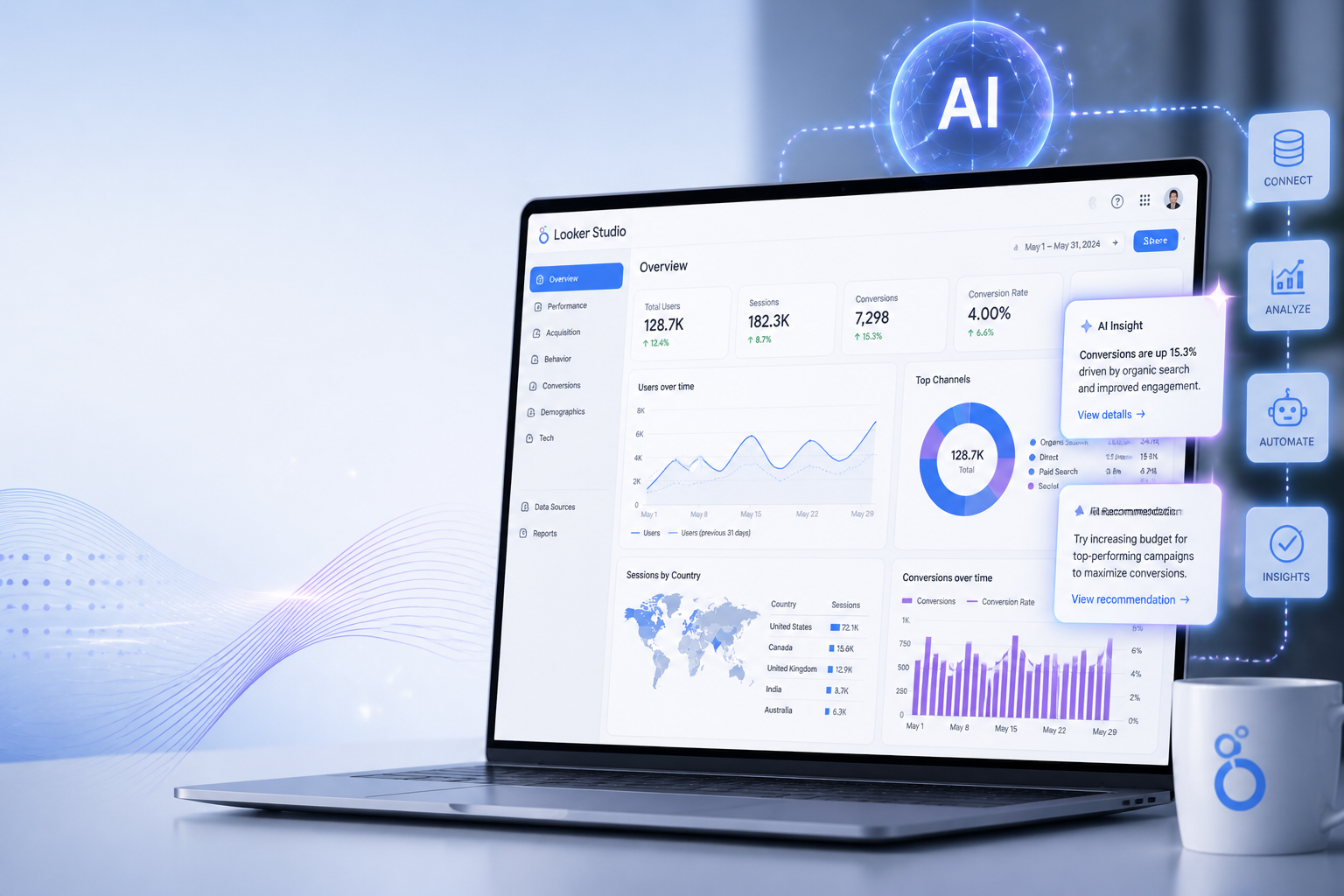
Artificial Intelligence is rapidly transforming the way businesses analyze, interpret, and visualize data. Traditional reporting methods that once relied heavily on manual processes are now evolving into intelligent, automated analytics ecosystems powered by AI.
One platform experiencing significant transformation in this AI-driven era is Looker Studio. Originally designed as a cloud-based dashboard and reporting tool, Looker Studio is now becoming smarter, faster, and more automated through AI-powered capabilities, predictive analytics, and machine learning integrations.
From automated insights and natural language querying to anomaly detection and predictive reporting, AI is fundamentally changing how businesses interact with dashboards and business intelligence platforms.
At KnexBI, businesses increasingly seek AI-enhanced reporting solutions to improve operational efficiency, accelerate decision-making, and build more intelligent dashboard environments.
In this blog, we'll explore how AI is changing Looker Studio reporting in 2026 and how organizations can leverage these advancements to gain a competitive advantage.
The Evolution of Business Reporting
Traditional reporting systems were primarily static and reactive. Businesses often had to:
- Export spreadsheets manually
- Build reports from scratch
- Analyze historical data
- Spend hours identifying trends
These processes consumed valuable time and often delayed decision-making.
AI is now transforming reporting from:
- Reactive → Predictive
- Manual → Automated
- Static → Intelligent
- Historical → Real-time
Modern AI-powered reporting systems can now:
- Detect trends automatically
- Generate insights instantly
- Predict future outcomes
- Recommend actions proactively
This evolution is significantly improving how businesses use Looker Studio dashboards.
1. AI-Powered Automated Insights
One of the biggest changes AI brings to Looker Studio reporting is automated insight generation.
Instead of manually analyzing charts and metrics, AI systems can automatically identify:
- Performance trends
- Sudden traffic spikes
- Revenue anomalies
- Customer behavior patterns
- Campaign performance shifts
Example
An AI-powered marketing dashboard can automatically highlight:
- Declining ad performance
- Unexpected conversion increases
- Seasonal traffic changes
- High-performing channels
This reduces manual analysis and helps decision-makers focus on strategy rather than data exploration.
2. Natural Language Queries and Conversational Analytics
AI is making reporting far more accessible through natural language processing (NLP).
Users no longer need advanced technical expertise to analyze data.
Instead, they can ask questions like:
- “Which campaign generated the highest ROI?”
- “Show revenue growth for the last six months.”
- “Which region has the highest customer churn?”
AI systems interpret these questions and generate visual reports automatically.
This conversational reporting experience simplifies analytics for:
- Executives
- Marketing teams
- Sales managers
- Non-technical users
As conversational analytics continues evolving, Looker Studio reporting is becoming increasingly user-friendly.
3. Predictive Analytics in Looker Studio
Traditional dashboards focus mainly on historical reporting. AI introduces predictive capabilities that allow businesses to forecast future outcomes.
AI-driven predictive analytics can help organizations:
- Forecast sales trends
- Predict customer churn
- Estimate future demand
- Identify operational risks
- Anticipate marketing performance
When integrated with cloud warehouses and machine learning platforms, Looker Studio dashboards can visualize predictive insights in real time.
This shift helps businesses move from:
- “What happened?”
- to
- “What is likely to happen next?”
4. AI-Based Anomaly Detection
One of the most valuable AI capabilities in reporting is anomaly detection.
AI algorithms can automatically identify unusual behavior patterns such as:
- Revenue drops
- Website traffic spikes
- Unexpected expense increases
- Inventory shortages
- Sudden campaign failures
Instead of relying on manual monitoring, businesses receive intelligent alerts when abnormalities occur.
Benefits
- Faster issue detection
- Reduced operational risk
- Improved incident response
- Better business continuity
AI-powered anomaly detection is especially useful for enterprises managing real-time dashboards and large-scale operations.
5. Smarter Data Visualization Recommendations
AI is also improving how dashboards are designed.
Modern AI-driven systems can recommend:
- Best chart types
- Visualization layouts
- KPI prioritization
- Dashboard structures
For example:
- Time-series data may automatically generate line charts
- Geographic datasets may suggest maps
- Correlation analysis may recommend scatter plots
This helps businesses create more effective and user-friendly dashboards without requiring advanced design expertise.
6. AI-Driven Data Preparation and Cleaning
Data preparation is often one of the most time-consuming parts of analytics workflows.
AI now helps automate:
- Data cleansing
- Duplicate removal
- Missing value handling
- Data categorization
- Data normalization
This significantly reduces manual effort and improves reporting accuracy.
Organizations integrating AI-powered ETL and cloud data pipelines with Looker Studio can accelerate reporting workflows dramatically.
7. Personalized Dashboard Experiences
AI enables personalized reporting experiences based on user behavior and preferences.
Different users can automatically receive dashboards tailored to:
- Department goals
- Frequently accessed KPIs
- User roles
- Business priorities
For example:
- Marketing teams see campaign metrics
- Finance teams see profitability dashboards
- Executives see strategic KPIs
This improves dashboard relevance and enhances decision-making efficiency.
8. AI-Powered Forecasting for Marketing Analytics
Marketing analytics is one of the areas where AI is transforming Looker Studio most aggressively.
AI-powered reporting can now:
- Predict campaign performance
- Forecast ad spend efficiency
- Analyze customer acquisition trends
- Optimize SEO reporting
- Identify audience segments
By integrating AI tools with platforms like:
- Google Analytics 4
- Google Ads
- BigQuery
businesses can create intelligent marketing dashboards that go beyond static reporting.
9. Real-Time Decision Intelligence
AI is helping businesses shift from standard reporting to decision intelligence systems.
Instead of only displaying data, AI-powered dashboards now:
- Recommend actions
- Suggest optimizations
- Prioritize alerts
- Identify opportunities automatically
For example:
- A sales dashboard may recommend reallocating budget to high-performing regions
- An SEO dashboard may identify declining keyword performance automatically
This proactive approach improves business agility significantly.
10. Integration with Machine Learning Platforms
Modern AI reporting ecosystems increasingly integrate with machine learning tools such as:
- Vertex AI
- BigQuery ML
- TensorFlow
- Python-based analytics pipelines
These integrations allow organizations to embed:
- Predictive models
- Risk scoring
- Classification systems
- AI recommendations
directly into Looker Studio dashboards.
This creates highly advanced analytics environments suitable for enterprise decision-making.
Challenges of AI-Powered Reporting
Although AI provides significant advantages, businesses still face several challenges.
- Data Quality Issues: AI systems depend heavily on clean and accurate data.
- Privacy and Governance: AI-powered analytics requires proper governance and security controls.
- Over-Automation Risks: Businesses should avoid relying entirely on automated insights without human validation.
- Infrastructure Complexity: Advanced AI reporting often requires cloud infrastructure and machine learning expertise.
Organizations must balance automation with governance and strategic oversight.
How KnexBI Helps Businesses Build AI-Powered Reporting Systems
At KnexBI, organizations leverage advanced analytics, cloud integration, and AI-driven dashboard solutions to modernize reporting environments.
KnexBI helps businesses:
- Optimize Looker Studio dashboards
- Integrate AI-powered analytics
- Build scalable reporting systems
- Improve dashboard performance
- Automate KPI monitoring
- Create predictive reporting workflows
By combining business intelligence expertise with modern AI technologies, organizations can unlock deeper insights and improve strategic decision-making.
The Future of AI in Looker Studio Reporting
AI-driven reporting is still evolving rapidly.
In the coming years, businesses can expect:
- Fully conversational dashboards
- Automated dashboard generation
- Real-time AI recommendations
- Deeper predictive analytics
- Autonomous reporting systems
- Advanced decision intelligence platforms
As AI becomes more integrated into business intelligence platforms, dashboards will evolve from simple reporting tools into intelligent business assistants.
Organizations that adopt AI-enhanced analytics early will gain significant competitive advantages through faster insights, smarter forecasting, and more efficient operations.
Fundamentals of AI
AI is fundamentally transforming Looker Studio reporting by making analytics:
- Smarter
- Faster
- More predictive
- More automated
- More accessible
From anomaly detection and natural language queries to predictive analytics and intelligent recommendations, AI-powered reporting is reshaping how businesses interact with data.
However, successful AI adoption requires more than simply adding automation. Businesses must also focus on:
- Data quality
- Dashboard optimization
- Governance
- Scalability
- Strategic implementation
Organizations that effectively combine AI with modern reporting systems will be better positioned to improve decision-making, enhance operational efficiency, and drive long-term business growth in 2026 and beyond.