

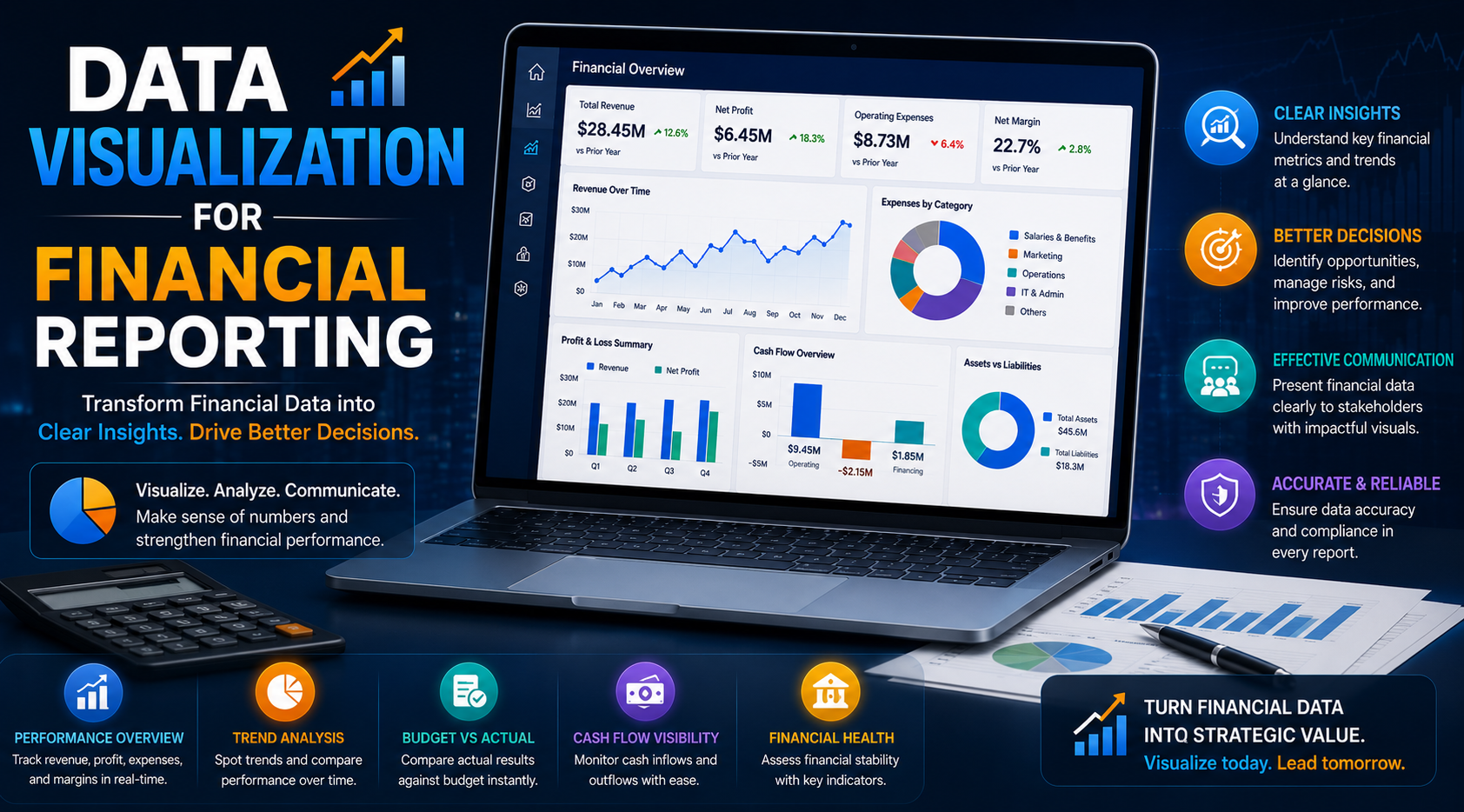
Financial reporting has evolved significantly over the past decade. Modern businesses no longer rely solely on static spreadsheets and lengthy financial statements to analyze performance. Organizations now require faster, clearer, and more interactive ways to understand financial data and support strategic decision-making.
This is where data visualization plays a critical role in financial reporting. Data visualization transforms complex financial information into interactive dashboards, KPI scorecards, charts, and real-time reports that make financial analysis easier to understand and act upon.
In today’s enterprise environment, finance teams handle enormous amounts of data related to:
- Revenue and expense allocation
- Corporate and department-level profitability
- Budgeting and rolling forecasting models
- Cash flow velocities
- Operational and infrastructure costs
Without effective visualization, interpreting financial performance can become slow, complex, and error-prone. At KnexBI, organizations increasingly implement financial reporting solutions using platforms such as Microsoft Power BI, Tableau, and Looker Studio to modernize financial analytics and improve executive reporting.
In this article, we’ll explore the importance of data visualization in financial reporting, major use cases, common challenges, best practices, and the future of visual financial analytics in enterprise organizations.
Why Financial Reporting Needs Data Visualization
Traditional financial reporting often depends heavily on static spreadsheets, lengthy word documents, dense PDFs, and manually compiled disclosures. Although these structural files remain necessary for statutory and legal filings, they introduce massive roadblocks into dynamic operational contexts:
- Sluggish retrospective analysis with slow lookup time
- Pervasive reporting delays due to slow cross-department data consolidation
- Cognitive information overload from thousands of identical cell blocks
- Inability to surface emerging trends or localized cost anomalies
Financial leaders require real-time visibility, fast reporting cycles, interactive slice-and-dice functionality, and forward-looking, predictive financial insights. Data visualization addresses these requirements by morphing massive ledgers into organized graphic structures. This visual approach allows operators to monitor corporate health, protect working capital, and guide long-term corporate planning.
The Growing Importance of Financial Analytics
Modern enterprises generate financial data continuously across transactional ERP modules, point-of-sale systems, global payroll networks, vendor invoicing queues, and core accounting databases. As transactions increase in complexity, companies require unified business intelligence networks to bridge system divides.
Advanced financial analytics is essential for strategic budgeting, variance tracking, multi-entity tax alignment, risk auditing, and automated executive reporting. Bringing data visualization into the analytical layer ensures that abstract transactions are automatically contextualized into clean business intelligence assets.
1. Simplifies Complex Financial Data
Financial records are extraordinarily dense and difficult to unpack quickly using row-by-row manual reviews. Data teams must coordinate conflicting ledger dimensions, changing amortization calendars, nested operational costs, and global currency adjustments.
Visualization engines untangle these overlapping rows using interactive trend charts, dynamic bridge diagrams, and color-coded waterfall models. Instead of losing hours tracing line exceptions across multiple sheets, management can isolate macro structural variations in seconds.
2. Improves Executive Decision-Making
Corporate executives rely on transparent financial inputs to steer firm strategy and protect operating margins. Centralized visual portals give leadership direct, on-demand clarity regarding revenue velocity, gross margins, budget burnout metrics, and alternative operational expense forecasts.
This rapid data delivery speeds up management decisions and replaces speculative guesswork during board updates, investor calls, regulatory reviews, and fiscal planning sessions.
3. Enables Real-Time Financial Monitoring
Relying strictly on historical lookback cycles creates a significant blind spot when market conditions shift rapidly. Real-time visual streams eliminate this latency by piping transactional data directly from payment gateways, bank clearing loops, and ERP sub-ledgers.
This immediate visibility gives treasury and financial controllers the agility to optimize intraday liquidity, audit unexpected spend run-rates, adjust credit exposure, and monitor cash burn trends as they unfold.
4. Enhances Financial KPI Tracking
Modern enterprise teams depend on automated reporting to track foundational performance indicators. Visualization software maps data to real-time indicator cards that track:
- Gross and net profit margins
- EBITDA and operating income ratios
- Operating Expense (OpEx) vs. Capital Expenditure (CapEx) metrics
- Days Sales Outstanding (DSO) and Accounts Receivable aging weights
Centralized corporate scorecards enable multi-period variance filtering and instantly surface structural underperformance before metrics slip past critical risk thresholds.
5. Improves Budgeting and Forecasting
Building precise budget profiles calls for clear visibility into historical cost behaviors and seasonal consumption cycles. Visual dashboard solutions plot actual spend timelines directly against pre-set fiscal limits and statistical prediction paths.
This structural alignment helps controllers quickly isolate budget leakage points, fine-tune departmental resource allocation, and leverage statistical forecasting to predict future operational runway with high accuracy.
6. Supports Financial Data Storytelling
A persistent obstacle for analytics teams is translating complex financial numbers into straightforward insights for non-technical stakeholders. Department heads, regional team managers, and product leads need clear explanations to guide their daily decisions.
Data visualization serves as an effective translator by arranging messy table parameters into linear visual narratives. By combining high-level overview cards with explicit performance trend annotations, dashboards present a transparent look at corporate health that anyone can follow.
7. Reduces Manual Reporting Effort
Traditional finance departments spend significant hours manually copying numbers between source databases, managing complex formula chains, and fixing accidental lookup breaks.
Modern business intelligence tools automate this entire layer—from database ingestion to visual report generation and delivery. Removing this manual work frees up core analysts to focus on identifying strategic business opportunities rather than wrestling with data prep.
8. Helps Identify Financial Risks
Visual finance portals act as an early-warning radar for risk compliance. Unusual procurement cost spikes, rapid margin deterioration across product lines, high bad-debt concentrations, and unexpected working capital drops stand out instantly when rendered through graphical exception heatmaps. Spotting these deviations early allows risk managers to act swiftly to protect the bottom line.
9. Improves Compliance and Audit Readiness
Enterprise organizations operate under strict international data rules and accounting compliance standards. Centralized analytics infrastructure logs complete database-to-dashboard tracking trails, providing clear data lineage. This centralized system simplifies internal audits, ensures consistent metric definitions, and streamlines external regulatory auditing.
10. Enables Department-Level Financial Visibility
Financial data is no longer siloed exclusively within finance departments. Branch managers, sales directors, and supply chain leaders need real-time insight into how their operational decisions directly impact corporate margins.
Secure, role-based visualization tools deliver filtered, relevant data directly to department leads. This accessibility fosters a proactive, data-backed culture where every unit takes ownership of fiscal responsibility.
Common Financial Dashboards Used by Enterprises
Enterprises deploy specialized dashboard layouts to track distinct dimensions of corporate performance:
- Executive Performance Summaries: High-level screens consolidating global EBITDA tracks, overall margin targets, and corporate growth trajectories.
- Interactive P&L Dashboards: Dynamic income statements enabling users to instantly drill down into specific revenue streams and localized expenses.
- Cash Flow Trackers: Real-time tools monitoring cash inflows, accounts payable aging, and rolling working capital reserves.
- Budget vs. Actual Monitors: Departmental views tracking actual spend against pre-set fiscal limits to flag cost overruns early.
Common Challenges in Financial Data Visualization
Deploying financial visualization without a solid strategy can create corporate bottlenecks. Organizations frequently run into issues with messy, unmapped ledger connections, conflicting metric definitions between separate offices, and sluggish dashboard loads caused by unoptimized database calls.
To build an effective, trusted system, organizations must prioritize clean backend data pipelines, establish uniform KPI governance, and follow performance-focused dashboard design practices.
Future of Financial Data Visualization
The future of corporate financial reporting centers around cloud scalability, embedded intelligence, and automated insight narratives. Modern data teams are leaning into cloud-native architectures to process complex ledgers effortlessly.
At the same time, the integration of conversational AI tools allows managers to query live datasets using simple text commands, instantly generating visual trend forecasts and anomaly callouts. This evolution is turning visualization platforms into strategic, active decision-intelligence centers.
How KnexBI Helps Businesses Modernize Financial Reporting
At KnexBI, we specialize in transforming disjointed financial data streams into secure, highly interactive, and lightning-fast corporate visual assets.
Our specialized team partners with finance departments to:
- Construct enterprise-grade dashboards across Power BI, Tableau, and Looker Studio
- Connect and unify disparate ERP, billing, and accounting software inputs into a single source of truth
- Optimize and tune sluggish dashboard rendering metrics and unoptimized data models
- Enforce strict role-based data row encryption and secure audit tracking
Our targeted technical consulting removes the burden of manual reporting work, allowing your finance leadership team to dedicate their energy to driving long-term enterprise growth.